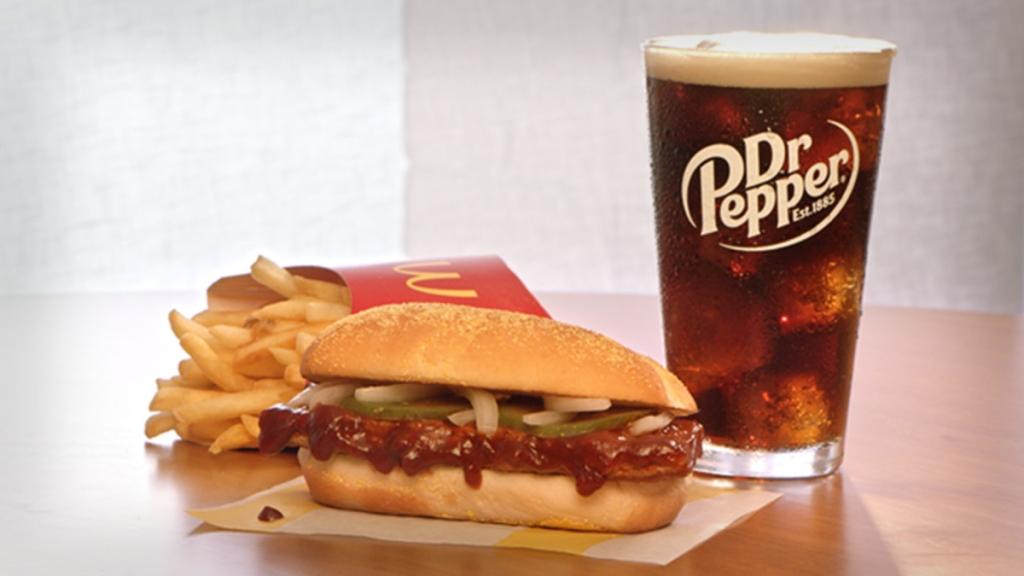
Starbucks’ fall Pumpkin Spice Latte and summer’s Chick-fil-A Peach Milkshake might be two of the most popular seasonal items you can find at fast-food restaurants.
However, the McDonald’s McRib is probably the longest-running limited-time menu item.
The McRib was introduced in 1980, and had a 20-year run before it was removed from McDonald’s permanent menu in the 2000s.
Still, it returns for a limited time every year, according to SEC filings, meaning it’s celebrating its 46th birthday this year. Fans of the seasonal sandwich never seem to get tired of it, and there are always protests when it disappears from the menu.
Most recently, in November 2025, the McRib became available for its annual limited-time/limited-market stint.
“The McRib is back!” is a phrase recognized nationwide, making fans of the sandwich excited to get their hands on one as soon as it becomes available. And McDonald’s has successfully leveraged the sandwich’s “scarcity” to drive sales across its many locations.
Right now you can find the McRib on menus in Atlanta, Chicago, Cleveland, Dallas, Los Angeles, Miami, Seattle, and St. Louis, among other cities, according to the McRib Locator, which tracks McRib sightings.
The McRib, made of pork and shaped to resemble a rack of ribs, is served on a bun with barbecue sauce, pickles, and onions.
McRib fans may assume that the sandwich is crafted using pork “rib” meat, but this particular pork patty doesn’t contain any rib bones, which is one reason McDonald’s is now the subject of a class-action lawsuit for deceptive labeling.
McDonald's
McDonald’s accused of deception over McRib ingredients
The class action lawsuit claims the fast‑food giant misled customers about the ingredients — allegations the company is vigorously rejecting.
The lawsuit, case no. 1:25-cv-15609, filed in U.S. District Court, Northern District of Illinois, Eastern Division, was brought by plaintiffs Peter Le, Charles Lynch, Dorien Baker, and Derrick Wilson, whose lawyers claim, “The name ‘McRib’ is a deliberate sleight of hand. By including the word ‘Rib’ in the name of the sandwich, McDonald’s knowingly markets the sandwich in a way that deceives reasonable consumers, who reasonably (but mistakenly) believe that a product named the “McRib” will include at least some meaningful quantity of actual pork rib meat, which commands a premium price on the market.”
Related: McDonald’s is unexpectedly closing another restaurant
The lawsuit further claims that McDonald’s also understood, or should have understood, that a reasonable consumer would not inherently know that the McRib does not contain pork rib meat.
“Our fan-favorite McRib sandwich is made with 100% pork sourced from farmers and suppliers across the U.S. – there are no hearts, tripe or scalded stomach used in the McRib patty as falsely alleged in this lawsuit,” McDonald’s countered in a statement shared with Fortune. “We’ve always been transparent about our ingredients so guests can make the right choice for them.”
While it remains to be seen if anything will come of this accusation, it’s not the first time McDonald’s has faced a class-action lawsuit.
McDonald’s past lawsuits, including the 1994 “hot coffee” case
One of the most famous U.S. product liability cases involved McDonald’s in 1994. That was the year a jury found McDonald’s liable for injuries a customer suffered after spilling hot coffee on her lap.
The case was the butt of late night comedians’ jokes, but it was not a laughing matter for McDonald’s: A jury awarded the victim $200,000 in compensatory damages — reduced to $160,000 because the jury found her 20 percent at fault — and $2.7 million in punitive damages for McDonald’s “callous” conduct (although a judge later reduced the amount), according to the Texas Trial Lawyers Association.
McDonald’s has been sued many times since, including the following.
- Byron Allen advertising discrimination lawsuit (2025). Media entrepreneur Byron Allen sued McDonald’s in federal court, accusing the company of racial discrimination because it failed to follow through on promises to increase advertising spending with Black-owned media companies. The lawsuit sought $10 billion in damages and was settled confidentially ahead of a scheduled 2025 trial, according to Reuters.
- Wage and hour class action lawsuit (2025). McDonald’s has faced multiple class action lawsuits alleging it failed to properly pay hourly workers for overtime, meal and rest breaks, and uniform-related expenses. In California, the company agreed to a $26 million settlement covering employees at corporate-owned restaurants, per On Labor. There were settlements addressing similar claims in other states.
- Oregon meal-break class action settlement (2025). A McDonald’s franchise operator in Oregon agreed to pay $3.55 million to settle a class-action lawsuit claiming employees were not paid for short meal breaks, a violation of state labor laws, according to Yahoo.
- Pelman v. McDonald’s obesity lawsuit (2002). In a high-profile case filed in the late 1990s, plaintiffs argued McDonald’s menu items contributed to childhood obesity, according to The New York Times. The lawsuit ultimately failed after a federal court denied class-action status.
McDonald’s best-selling menu items
McDonald’s is a global fast-food leader, referring to itself as the “world’s leading global foodservice retailer” with over 44,000 locations in more than 100 countries.
McDonald’s serves:
- 30 million McRib sandwiches a year, according to the lawyers who filed the most recent lawsuit
- 9 million pounds of fries every single day worldwide, according to Food Republic
- 3.6 billion orders of fries per year (equivalent to over 255 billion individual fries, per Accio
- 550 million Big Macs per year in the United States, as reported by Chef’s Resource
- 900 million Big Macs annually worldwide, according to Flavor365
- 75 to 100 million Chicken McNuggets every day worldwide, per Flavor365
Related: McDonald’s expected to bring back beloved childhood favorite in 2026